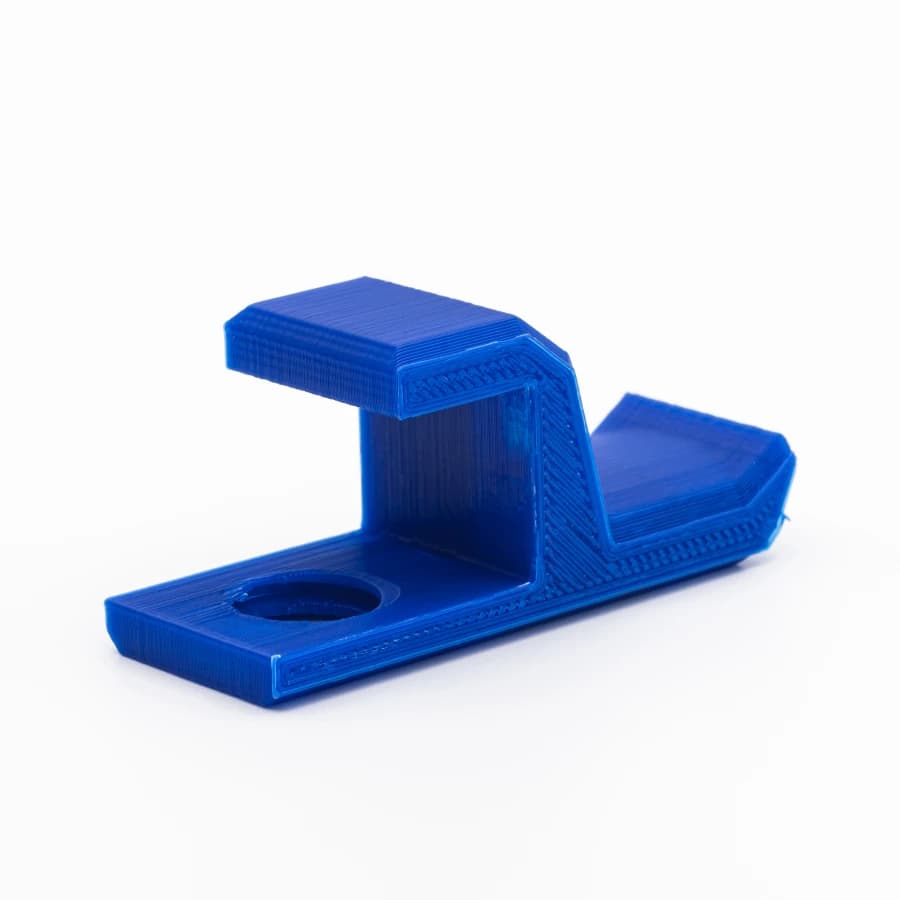
Carbon Fiber PLA
Composites
Wear resistantFunctional
Carbon Fiber PLA blends standard PLA with chopped carbon fiber, substantially increasing stiffness and dimensional stability. Parts hold their shape and resist bending under load far better than standard PLA, with minimal warping during cooling. This comes at a real cost to toughness: Standard PLA is already relatively brittle, and carbon fiber reinforcement makes it more so, since the rigid fibers don't stretch or absorb impact energy the way the polymer alone can, making cracks more likely under sudden impact. Heat resistance sees only a modest improvement, and it is still well below true heat-resistant options like ABS, ASA, or nylon composites. Carbon Fiber PLA suits drone frames, mounting brackets, tooling, and structural housings that need to hold a precise shape under load without significant flexing or impact.
Available finishes
Each finish can be combined with the available colors at checkout.

Standard
10 colorsThe standard (as-printed) finish on FDM parts shows the natural texture of layer-by-layer printing. The visibility of the layer lines depends on part geometry and orientation, plus light marks where support material was removed.

Sanded
10 colorsThe sanded finish on FDM parts reduces the visibility of layer lines compared to the standard finish, though some surface texture generally remains. How much smoothness is achieved can vary depending on the material.